Blog

  • Recovering flow dynamics from non-time-resolved measurements

    Standard particle image velocimetry (PIV) systems record image pairs separated by a short interval, but successive pairs are often far apart in time. The resulting data are not time-resolved, which makes it difficult to extract temporal dynamics with conventional modal-analysis methods such as dynamic mode decomposition (DMD).

    Gap-based dynamic mode decomposition (gDMD) addresses this by extracting DMD modes from standard, non-time-resolved PIV data. The approach is described in a paper accepted in Physical Review Fluids (September 2026): doi.org/10.1103/4g2g-7mh7.
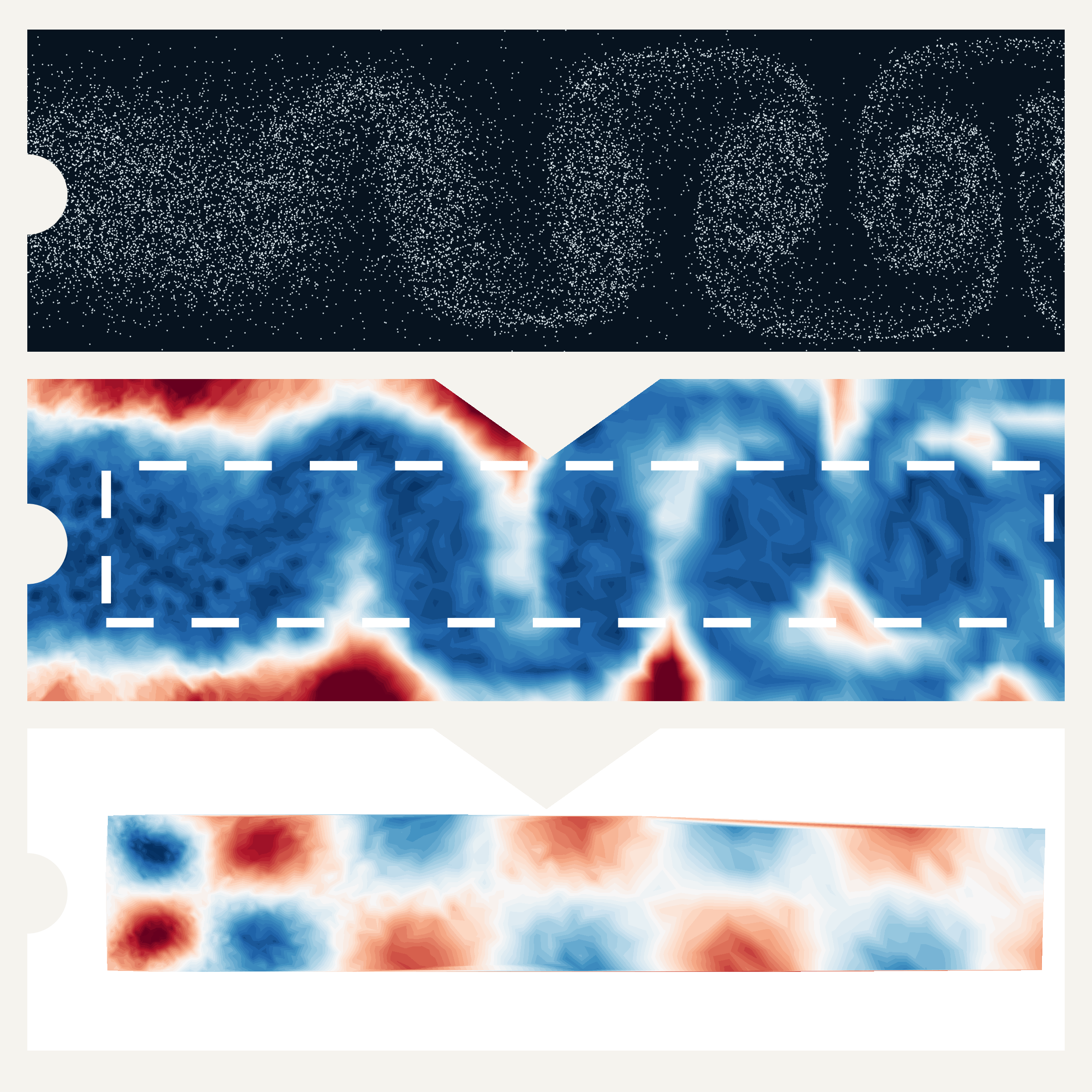
    Visual summary: dynamic mode decomposition using standard PIV data
  • Turbulence, instability and aeroacoustic sound

    Turbulent flows contain structures that evolve across a wide range of scales. Some of these structures are linked to instability mechanisms and can organise the velocity and pressure fluctuations that contribute to sound.

    A central question for the lab is how these dynamics can be identified and interpreted. A central aim is to connect measurable flow patterns to the physical processes that sustain them, and to examine how those processes relate to aeroacoustic sound generation.

    This requires a combination of measurements, numerical data and analysis methods that can distinguish coherent dynamics from broadband turbulent motion.

  • Recovering flow dynamics from non-time-resolved measurements

    Standard particle image velocimetry (PIV) systems record image pairs separated by a short interval, but successive pairs are often far apart in time. The resulting data are not time-resolved, which makes it difficult to extract temporal dynamics with conventional modal-analysis methods such as dynamic mode decomposition (DMD).

    Gap-based dynamic mode decomposition (gDMD) addresses this by extracting DMD modes from standard, non-time-resolved PIV data. The approach is described in a paper accepted in Physical Review Fluids (September 2026): doi.org/10.1103/4g2g-7mh7.

    Visual summary: dynamic mode decomposition using standard PIV data
  • Turbulence, instability and aeroacoustic sound

    Turbulent flows contain structures that evolve across a wide range of scales. Some of these structures are linked to instability mechanisms and can organise the velocity and pressure fluctuations that contribute to sound.

    A central question for the lab is how these dynamics can be identified and interpreted. A central aim is to connect measurable flow patterns to the physical processes that sustain them, and to examine how those processes relate to aeroacoustic sound generation.

    This requires a combination of measurements, numerical data and analysis methods that can distinguish coherent dynamics from broadband turbulent motion.

  • Hello world!

    Welcome to METU Blog Service. This is your first post. Edit or delete it, then start blogging!