The Power of Distance Education: The Zimbabwe Case
In the 1980s, Zimbabwe became an independent country after a long and difficult process. One of the first decisions of the new government was to provide free and universal education for all children. However, this decision quickly created a major challenge: there were not enough teachers to educate the rapidly increasing number of students.
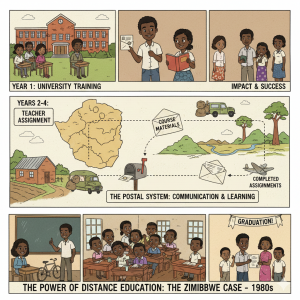 At this point, distance education became a necessity rather than a choice. Teacher trainees received face-to-face education during their first year at university. In the following years, they were assigned to schools across the country, where they worked as teachers while continuing their education through distance learning. This system allowed them to gain real classroom experience without interrupting their academic training.
What makes this example especially interesting is the technology used. Unlike modern distance education systems that rely on the internet, the main communication tool in Zimbabwe was the postal system. Course materials and assignments were sent and returned by mail. Although this method was simple, it was highly effective because it matched the country’s conditions and needs.
This case clearly shows that the success of distance education does not depend on advanced technology, but on choosing the most appropriate tools to support communication and learning.
Here I put the link for your research:
https://files.eric.ed.gov/fulltext/ED541571.pdf?utm
THE INTERNET—WHY DOES IT MATTER?
As a foundation for current approaches to distance education, it is helpful to understand
what the Internet is and how it works. The Internet is not a single, clearly defined entity,
but a meta-network of interconnected networks that share a common language, TCP-IP
(transmission control protocol/Internet protocol). (A protocol is an electronic language that
computers use to communicate with one another and exchange data. Protocols are roughly
analogous to the languages humans use to communicate and share information.) These net
works are in a constant state of evolution, with thousands of vendors making changes on an
almost daily basis.
The Internet has no international headquarters or mailing address, no chief executive
officer or board of directors, no stockholders to whom it must be accountable, and no toll
free telephone number to call for assistance or information. This is not to say that the Internet is an anarchy, although some cynical observers might disagree. Much of the planning and
coordination responsibility is assumed by the Internet Society, an international, nonprofit
organization established for the purposes of “global cooperation and coordination for the
Internet and its internetworking technologies and applications.” Founded in 1991, the soci
ety facilitates the development and implementation of Internet standards and policies and
holds oversight responsibilities over several important boards and task forces that address
Internet issues. Membership in the Internet Society is free and open to all interested persons
anywhere in the world, including the readers of this book.
