A Look at Best Practices

Designing online courses is relatively easy; however, for distance education to be successful, not only individual courses but the entire program must be carefully planned. Designing a distance education program is a much more complex process than designing a single course. Although Orellana’s study published in 2009 addressed important issues related to online course design, it did not explain in detail how to design a comprehensive online program.

Many schools and universities are gradually transitioning from traditional education to distance education. This transition usually begins with offering parts of courses online, followed by fully online courses, blended learning, and eventually complete distance education programs. However, this process is often carried out through trial and error rather than systematic planning based on research.
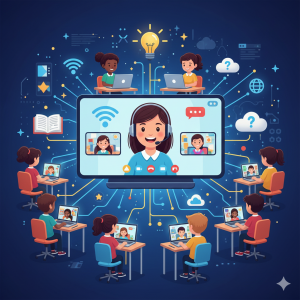
The text emphasizes that two main components are necessary for distance education to become a central approach within an institution. The first component is a comprehensive academic technology and distance education plan that includes vision and mission statements, goals, policies, timelines, and resources. The second component is an implementation process that supports the diffusion of distance education by involving stakeholders and promoting success step by step.

In this process, teachers and instructors play a key role. While leadership support is important, the success of distance education largely depends on the educators who implement the system. Therefore, collaboration among instructors, administrators, instructional designers, and support staff is essential.

In conclusion, a successful distance education program requires strong leadership, needs analysis, a detailed technology plan, evaluation processes, instructional design models, qualified instructors, technical support services, course management systems, and an adequate budget. When these elements come together, distance education programs become sustainable and effective.

Here I put the link for your research:

https://www.uky.edu/~gmswan3/609/Clark_1983.pdf?utm
Technologies, the Internet, and Distance Education

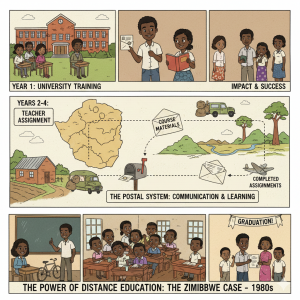
The Power of Distance Education: The Zimbabwe Case

In the 1980s, Zimbabwe became an independent country after a long and difficult process. One of the first decisions of the new government was to provide free and universal education for all children. However, this decision quickly created a major challenge: there were not enough teachers to educate the rapidly increasing number of students.

At this point, distance education became a necessity rather than a choice. Teacher trainees received face-to-face education during their first year at university. In the following years, they were assigned to schools across the country, where they worked as teachers while continuing their education through distance learning. This system allowed them to gain real classroom experience without interrupting their academic training.
What makes this example especially interesting is the technology used. Unlike modern distance education systems that rely on the internet, the main communication tool in Zimbabwe was the postal system. Course materials and assignments were sent and returned by mail. Although this method was simple, it was highly effective because it matched the country’s conditions and needs.

This case clearly shows that the success of distance education does not depend on advanced technology, but on choosing the most appropriate tools to support communication and learning.

Here I put the link for your research:

https://files.eric.ed.gov/fulltext/ED541571.pdf?utm

THE INTERNET—WHY DOES IT MATTER?
As a foundation for current approaches to distance education, it is helpful to understand
what the Internet is and how it works. The Internet is not a single, clearly defined entity,
but a meta-network of interconnected networks that share a common language, TCP-IP
(transmission control protocol/Internet protocol). (A protocol is an electronic language that
computers use to communicate with one another and exchange data. Protocols are roughly
analogous to the languages humans use to communicate and share information.) These net
works are in a constant state of evolution, with thousands of vendors making changes on an
almost daily basis.
The Internet has no international headquarters or mailing address, no chief executive
officer or board of directors, no stockholders to whom it must be accountable, and no toll
free telephone number to call for assistance or information. This is not to say that the Internet is an anarchy, although some cynical observers might disagree. Much of the planning and
coordination responsibility is assumed by the Internet Society, an international, nonprofit
organization established for the purposes of “global cooperation and coordination for the
Internet and its internetworking technologies and applications.” Founded in 1991, the soci
ety facilitates the development and implementation of Internet standards and policies and
holds oversight responsibilities over several important boards and task forces that address
Internet issues. Membership in the Internet Society is free and open to all interested persons
anywhere in the world, including the readers of this book.

What Is Distance Education?

WHAT IS DISTANCE EDUCATION?

It is the nature of questions that they are easier to ask than to answer. This is true of the
question “What is distance education?” for at least several reasons. First, distance has mul
tiple meanings, although this book advocates the definition presented earlier and in. Distance can mean geographical distance, time distance, and possibly even
intellectual distance.

Here I put the link for your research:

https://files.eric.ed.gov/fulltext/ED530060.pdf?utm

Second, the term distance education has been applied to a tremendous variety of programs serving numerous audiences via a wide variety of media. Some use print, some use
telecommunications, and many use both. Finally, rapid changes in technology challenge
the traditional ways in which distance education is defined.


Traditional education takes place at the same time in the same place. This is typically
the regular self-contained classroom that most often is teacher centered. Different-time,
same-place education means that individual learning occurs in a learning center, or that
multiple sections of the same classes are offered so students can attend the class in the same
place at a time they choose. This is education that is available at different times to students
but in the same place, such as the media center or computer laboratory.
The last two categories focus on education occurring in different places. Instruc
tion can be delivered to different places at the same time when telecommunications sys
tems are used. Often, television is used to connect the local classroom with the teacher
and students to learners at a distance. Satellite, compressed video, fiber-optic systems,
and webcasting are increasingly used for same-time, different-place education. Increas
ingly, web-based video systems such as Zoom are being used to deliver live instruction.