About Me


My name is Aysima Sabancılar, and I am a third-year student in the Computer Education and Instructional Technology (CEIT) program at Middle East Technical University (METU). My academic interests include distance education, educational technologies, and the design of digital learning environments.

The purpose of this blog is to provide a general overview of distance education. Distance education is a broad field that includes many concepts, models, and practices. In this blog, I aim to briefly introduce some of the fundamental aspects of distance education rather than offering an in-depth analysis. The posts presented here focus on a superficial and introductory level of the topic, based on selected academic sources and examples.

This blog was created as part of a course project and serves as an introductory resource for understanding the basic ideas related to distance education.

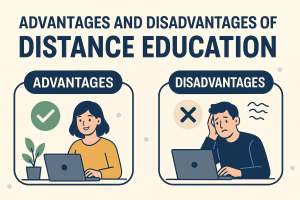
Advantages and Disadvantages of Distance Education

Distance education offers several benefits for learners. One of the main advantages is flexibility, as students can study at their own pace and from any location. This allows learners to balance education with work or personal responsibilities. Distance education also increases access to education by enabling students from different regions to participate in learning without physical attendance.

Another advantage is the development of independent learning skills. Students are encouraged to manage their time effectively and take responsibility for their own learning process using digital platforms and online materials.

However, distance education also has some disadvantages. Limited face-to-face interaction may reduce social engagement and immediate feedback between students and instructors. In addition, distance education requires strong self-discipline and technical skills, and technical problems such as internet issues may negatively affect learning.

In conclusion, distance education provides flexibility and accessibility, but it also requires motivation and technological readiness from learners.

Reference:
www.youtube.com/watch?v=06LoQ2Zg8Y8

What is Distance Education?


Distance education is a form of education in which learners and instructors are separated by time, location, or both. Instead of meeting in a traditional classroom, teaching and learning activities are carried out through various communication technologies such as printed materials, audio and video recordings, computers, and the internet.

According to the literature, distance education is not a new concept. It has evolved over time, starting with correspondence courses and later incorporating radio, television, and eventually online learning environments. What distinguishes distance education from traditional education is the planned and systematic use of instructional materials and communication technologies to support learning when direct face-to-face interaction is not possible.

One of the most important characteristics of distance education is learner independence. Students are expected to take more responsibility for their own learning by managing their time, accessing course materials, and engaging with content independently. At the same time, interaction remains a key element. Interaction can occur between students and instructors, among students, and between students and learning materials through discussion forums, emails, video conferences, and online platforms.

Distance education also aims to increase access to education. It provides learning opportunities for individuals who may not be able to attend traditional classrooms due to geographical, professional, or personal constraints. For this reason, distance education has become an important component of lifelong learning and higher education systems worldwide.

In recent years, advances in digital technologies have significantly expanded the possibilities of distance education. Learning management systems, multimedia content, and interactive tools have made it possible to design rich and engaging learning experiences even when learners and instructors are physically separated.

Reference:
Gunawardena, C. N., & McIsaac, M. S. (2004). Distance Education.
Available at:
ocw.metu.edu.tr/file.php/118/Week10/Gunawardena-McIsaac-distance-ed.pdf